

Prediction Market V2
AI-powered outcome-based participation platform
Document Version: 2.0
Last Updated: January 2026
Smart Contract Version: Solidity ^0.8.24
MiCA-Aligned Disclosure

Abstract
Zetarium Predictions is an on-chain outcome-based participation platform enabling users to engage in prediction markets with transparent settlement. Prediction markets allow participants to express expectations about future outcomes via market participation rather than opinion or speculation alone.
Disclaimer: Participation in prediction markets involves risk. This document is for informational purposes only. Zetarium does not provide investment advice, guarantees, or custodial services.
1. Overview
1.1 What are Prediction Markets?
Prediction markets are platforms where participants can express expectations about future outcomes through market mechanisms. Unlike traditional speculation, prediction markets utilise:
- On-chain accounting
- Public settlement logic
- Deterministic or oracle-assisted resolution
This minimises trust assumptions and improves fairness.
1.2 Market Design
Each prediction market defines:
| Component | Description |
|---|---|
| Event Definition | A specific event or outcome set |
| Participation Conditions | Rules for joining and trading |
| Settlement Criteria | How outcomes are determined |
| Resolution Logic | AI-based or price-based determination |
Markets may include binary or multi-outcome structures and are designed for transparency and auditability.
1.3 Strategic Role
Predictions serve to:
- Expand user participation beyond traders
- Increase engagement and platform stickiness
- Generate complementary liquidity flows
- Support decentralised information discovery
Important: Participation does not imply guaranteed outcomes or returns.
2. System Architecture
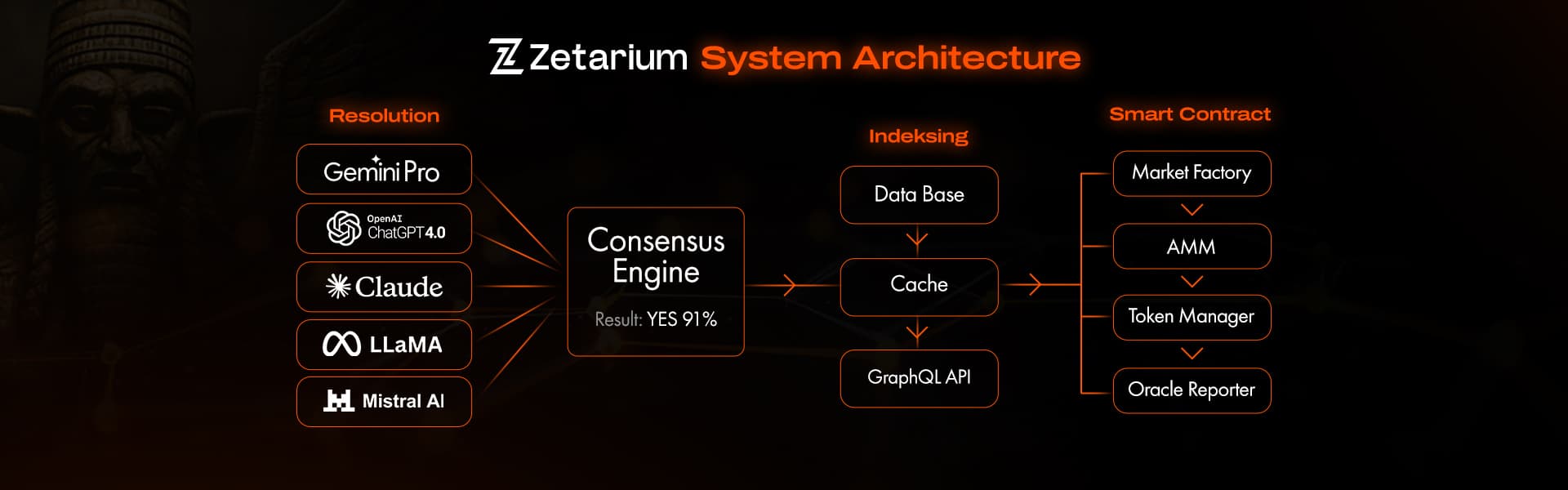
The Zetarium Predictions protocol consists of three main layers:
| Layer | Description |
|---|---|
| Smart Contract Layer | Market management and asset control on the blockchain |
| Indexing Layer | Fast access and querying of blockchain data |
| Resolution Layer | AI-powered automatic market settlement system |
Users
  |
  v
Frontend (Web Interface)
  |
  v
Application Layer
  +- Predictions Engine
  |     +- Market Logic
  |     +- Settlement Rules
  |     +- Oracle Layer
  |
  v
Smart Contracts (On-Chain Settlement)
  |
  v
Blockchain Infrastructure (BNB Chain)
3. Protocol Components
3.1 Conditional Token System
Zetarium Predictions uses the Gnosis Conditional Tokens Framework to manage tokens representing outcomes of future events. The system operates in binary (YES/NO) format.
How It Works
When a market is created, separate token classes are generated for each possible outcome. Users deposit stablecoins like USDC to receive outcome tokens.
| Scenario | Outcome |
|---|---|
| Correct predictors | Can exchange tokens 1:1 for collateral |
| Wrong predictors | Tokens become worthless |
This mechanism guarantees market settlement and ensures fair gains or losses.
3.2 Automated Market Maker (AMM)
Zetarium provides liquidity and pricing through an AMM system using the Constant Product Formula:
$$x \times y = k$$
Core Principles
| Principle | Description |
|---|---|
| Liquidity Pools | Users can become LPs by depositing USDC |
| Automatic Pricing | Prices determined by token reserve ratios |
| LP Earnings | Fees from each trade added to pool value |
| Arbitrage Mechanism | Price imbalances corrected by arbitrageurs |
3.3 Optimistic Oracle System
The security and verification layer uses an optimistic oracle model inspired by UMA Protocol.
Core Philosophy
"Correct information is provided most of the time; intervention is only required in case of errors."
Operating Mechanism
| Step | Action |
|---|---|
| 1 | Bond Deposit: Reporter deposits USDC collateral |
| 2 | Outcome Reporting: Market outcome reported, challenge period begins |
| 3 | Dispute Process: Auto-approval if no dispute, voting if disputed |
| 4 | Voting: Governance token holders vote for correct outcome |
| 5 | Finalisation: Correct report → bond returned, wrong → slashing |
Warning: The system is designed based on game theory principles. The cost of false reporting exceeds potential gains.
4. AI-Powered Resolution (V2 Feature)
4.1 Multi-AI Verification System
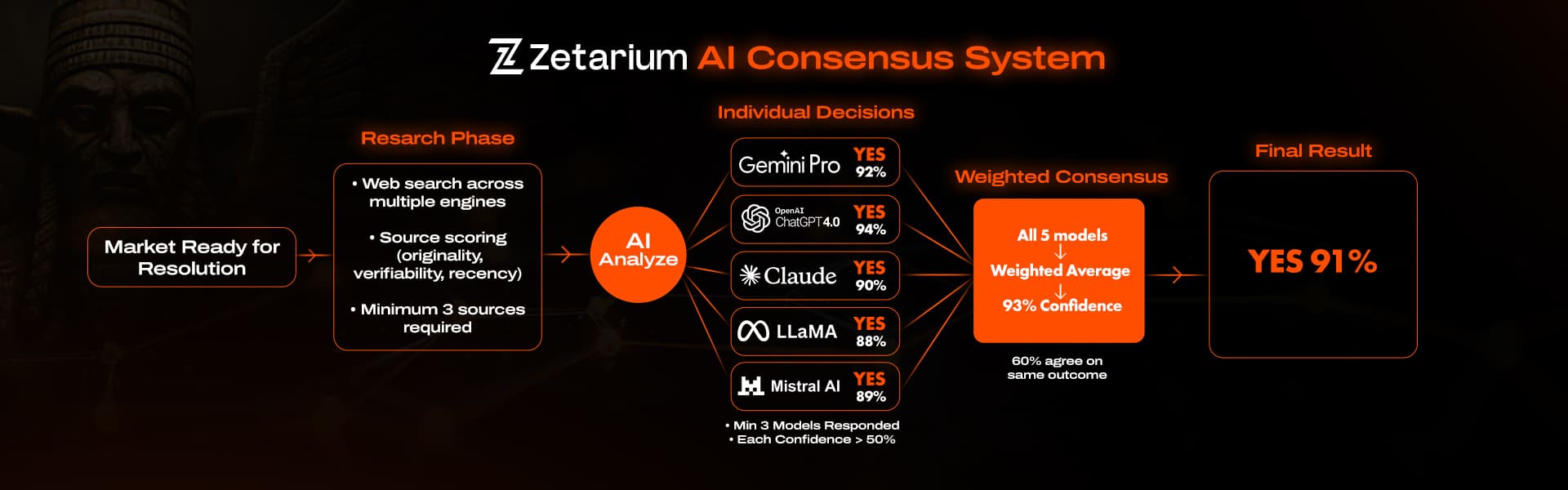
The most innovative feature of Zetarium Predictions V2 is that multiple independent AI models form consensus to determine market outcomes.
Decentralised AI Consensus
Instead of trusting a single AI model, multiple models from different organisations are used:
| Model | Organisation | Expertise |
|---|---|---|
| Gemini Pro | Fact-checking expertise | |
| GPT-4o | OpenAI | Advanced reasoning capabilities |
| Claude Sonnet | Anthropic | Nuanced understanding |
| Llama 3.1 | Meta | Open-source verification |
| Mistral Large | Mistral AI | European perspective |
4.2 Research and Reasoning Orchestration
The orchestration system disciplines web searching and logical inference:
| Principle | Description |
|---|---|
| Topic-specific trust network | Source only trusted in relevant domain |
| Source scoring | Originality, verifiability, recency, independence |
| Search strategy | Multiple engines with operator-supported queries |
| Logical chain | Claim → Evidence → Contradiction detection → Conclusion |
| Weighting | Trusted sources receive higher impact coefficients |
4.3 Consensus Algorithm
Weighted Voting System
Each AI model's decision is weighted by its confidence score. At least 60% of the total weight must converge on the same outcome.
Minimum Requirements
| Requirement | Value |
|---|---|
| Minimum successful AI responses | 3 models |
| Minimum confidence score per model | 50% |
| Minimum source references | 3 different sources |
| Time verification | Before resolution time |
4.4 Evidence Report System
A detailed evidence report is created for each market resolution:
| Component | Content |
|---|---|
| AI Model Results | Each model's decision and confidence score |
| Source Archiving | Web sources uploaded to Wayback Machine and IPFS |
| Consensus Details | Voting results and power distribution |
| Cryptographic Signature | Digital signature proving report authenticity |
| IPFS Storage | Permanent, decentralised storage |
4.5 Price-Based Resolution
For objective data like cryptocurrency prices, a deterministic oracle system is used:
| Oracle | Description |
|---|---|
| Chainlink | Decentralised price feeds |
| Pyth Network | High-frequency price data |
| Uniswap V3 | On-chain liquidity pools |
| Binance | Centralised exchange prices |
5. Market Lifecycle
5.1 Market Creation
A user or whitelisted address creates a new prediction market. Market information is recorded on the blockchain.
5.2 Liquidity Provision
Liquidity providers (LPs) deposit USDC to receive LP tokens and earn a share of trading fees.
5.3 Trading
Users buy and sell YES or NO tokens through the AMM. Prices update according to supply-demand balance.
5.4 Resolution Process
| Type | Process |
|---|---|
| AI-Based Markets | Multiple AI models research → Consensus → Evidence report → Reporting |
| Price-Based Markets | Multi-oracle price fetch → Median calculation → Threshold comparison |
5.5 Dispute Process
A 1-hour challenge period begins for reported outcomes:
| Situation | Result |
|---|---|
| No Dispute | Automatically approved and finalised |
| Disputed | Community voting begins |
5.6 Redemption
When the market is finalised:
- Correct predictors: Exchange tokens 1:1 for USDC
- LPs: Burn LP tokens to claim pool share and fees
6. Security Mechanisms
6.1 Economic Security
| Mechanism | Description |
|---|---|
| Bond System | Cost of false reporting exceeds potential gains |
| Slashing Mechanism | False reporters lose 100% of bond |
| Whistleblower Reward | Disputers receive share of slashed bonds |
6.2 AI Security
| Protection | Description |
|---|---|
| Prompt Injection Protection | User inputs marked as "untrusted" |
| Multi-Model Tolerance | Single AI error caught by consensus |
| Evidence Archiving | All sources uploaded to IPFS and Wayback |
| Confidence Thresholds | Low confidence outcomes marked as "UNCERTAIN" |
6.3 Smart Contract Security
| Protection | Description |
|---|---|
| Reentrancy Protection | Protection against repeated call attacks |
| Safe Token Transfers | Secure libraries for ERC20 |
| Access Control | Critical functions only callable by authorised addresses |
| Overflow Protection | Automatic protection with Solidity 0.8+ |
7. Risk Disclosure
Participation Risks
Participation in Zetarium Predictions involves risks including:
| Risk Category | Description |
|---|---|
| Market Risk | Prediction outcomes may result in total loss of position |
| Smart Contract Risk | Despite audits, vulnerabilities may exist |
| Oracle Risk | AI or price oracle failures may affect resolution |
| Liquidity Risk | Insufficient liquidity may impact trading |
| Regulatory Risk | Regulatory treatment of prediction markets may change |
Important Disclaimers
- Zetarium provides no guarantees regarding market outcomes
- Participation does not constitute investment advice
- Users should only participate with funds they can afford to lose
- Past performance does not indicate future results
8. Settlement & Transparency
Prediction markets utilise:
- On-chain accounting
- Public settlement logic
- Deterministic or oracle-assisted resolution
This minimises trust assumptions and improves fairness.
Resources
| Resource | Link |
|---|---|
| Website | prediction.zetarium.world |
| Documentation | docs.zetarium.world |
| @Zetarium_ | |
| Telegram | t.me/Zetarium_World |
| GitHub | github.com/zetariumworld |
This documentation is provided for informational purposes only. Zetarium does not provide investment advice, guarantees, or custodial services.